Petersburg is a city about 20 miles south of Richmond, Virginia. It was a major railroad hub before the Civil War. During the war, almost all the supplies used by the people of Richmond, as well as the Army of Northern Virginia, came through Petersburg. U.S. Grant, after fighting Lee for over a month, decided that the best way to defeat Lee’s army was to capture Petersburg. To keep this brief, cautious and timid generals caused him to miss his chance to capture Petersburg almost without a fight, and Grant was forced into a 9 and a half month siege. I won’t bore you with everything, I just want to share one part of the campaign.
Some of the Union soldiers ended up in a position not far from the Confederate lines. They decided that rather than having to go over the top, they should run a mine underneath the nearby Confederate fort and blow it up. This tunnel would be over 500 feet long, which the Army Corps of Engineers said was impossible. The men who had proposed the mine were coal miners from Pennsylvania. Who do you think won that argument?
So they dug the mine, loaded it with gunpowder, and set it off. To keep this brief, the unit selected and trained to lead the assault, a division of colored troops (their term for it, not mine; don’t shoot me) was removed at the last moment from that role. The division thrown in instead had no training, and to start with they panicked when the mine went off. When they finally went forward, instead of going around the hole in the ground, they climbed down in to it, which trapped them. When the Confederate forces converged on the area, it was the proverbial fish in a barrel. The attack failed.

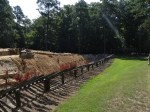

The top two pictures show a recreation of the trenches as they would have looked at Petersburg, which leads me to the preview. Standard practice back then was when other nations went to war, the neutral nations would send “observers.” The purpose of these was not to ensure good behavior on the part of the combatants. They were there to see if they could learn new ideas or methods of waging war, or new technologies. So, Petersburg was essentially 9 months of trench warfare. Attackers would climb out of their trenches, run across no-mans-land, and try to capture the enemies lines, more often than not being shot to pieces instead. Sound familiar? Let me give you a hint: WWI. Apparently the European observers watching the Americans fight at Petersburg learned nothing, because they would make the same mistakes just 50 years later, except they would do it for 4 years, not just 9 months.
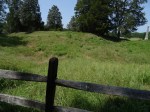
Anyway, the bottom two show the area where the Crater (the name of the battle involving the mine) took place. The hole was filled in, being more or less a grave for some 4000 men. The U.S. army decided they should remove the bodies and rebury them in a military cemetery, but stopped after maybe a few hundred. I’ll let you think about that.
Next, I wanted to visit a hero of mine, James Ewell Brown Stuart. Most just called him Jeb. He was Lee’s Cavalry commander, and according to John Sedgwick, who had served with Stuart before the war, and was a Union general, Stuart was the best Cavalry officer the U.S. had ever foaled. During the Battle of Spotsylvania, the Union cavalry under Phil Sheridan left on a raid with about 10,000 riders. Stuart took off after them with about 4,000. Stuart was able to get between Sheridan and Richmond, at a place called Yellow Tavern. There’s not much left of the battlefield, it’s been mostly turned into houses, or built over by new roads, etc., but I found a marker that shows where he was wounded. He was taken to Richmond, where he died the next day. The saddest part was, as he was riding to catch Sheridan, he briefly stopped to check on his wife and children. Stuart didn’t even have time to dismount. His wife, due to difficulties contacting her, and with delays in her travel to Richmond, arrived after he died. Here is a picture of the monument marking where he was wounded (the one on the right), and a picture of where he is buried in the Hollywood Cemetery (yes, that is its name) in Richmond, where he is buried next to his wife.


Now some of you might ask me why I count him a hero, when he was a Confederate, fighting against the government, and fighting for slavery. I am not going to get into a defense of him here. I admire him because he was brave, and he was valiant, and he was faithful. He wasn’t perfect, he made mistakes, but he learned and moved on. If I can only have heroes, or only have respect for people I agree with 100%, I will have no one on that list, not even myself. That is why I am proud to call him a hero, along with many other individuals. Eventually you may meet a few more on here. I would be interested to hear about some of my readers’ (all 5 of you) heroes. Who do you admire, and why?
Happy Road-Tripping!

 Ramblings of a Wandering Man