Pop Quiz! What day in America’s History saw more men end up as casualties than any other day? Hint: It’s not D-Day. If you said Antietam, you are correct. If you said Sharpsburg, you are correct. Both names are commonly used. If you said anything else, sorry, no prize for you. Antietam had at least twice as many casualties as D-Day, and more than the Revolutionary War, Mexican-American War, War of 1812, and Spanish American War combined! At least 4,000 dead, 17,000 wounded, and 2,000 missing. D-Day had about 10-12,000 total. Something to ponder.
I took a lot of pictures, but I will only post a few here, of what I feel are the important points of the battle.


Now, the first thing about Antietam is that it took place in three parts. You could almost say it was three separate battles in one day. Ok, enough of that. The building you see is the Dunker Church. This was the key to the first phase of the battle. The Union army had this as their goal, the Confederate army was defending the position. The other picture (I guess I should have got a little closer) is The Cornfield. This is where most of the fighting took place, as it is just north of the Dunker church. When one Confederate General who sent his men in here, John Bell Hood, was asked where his division was, he answered, “Dead on the field.”
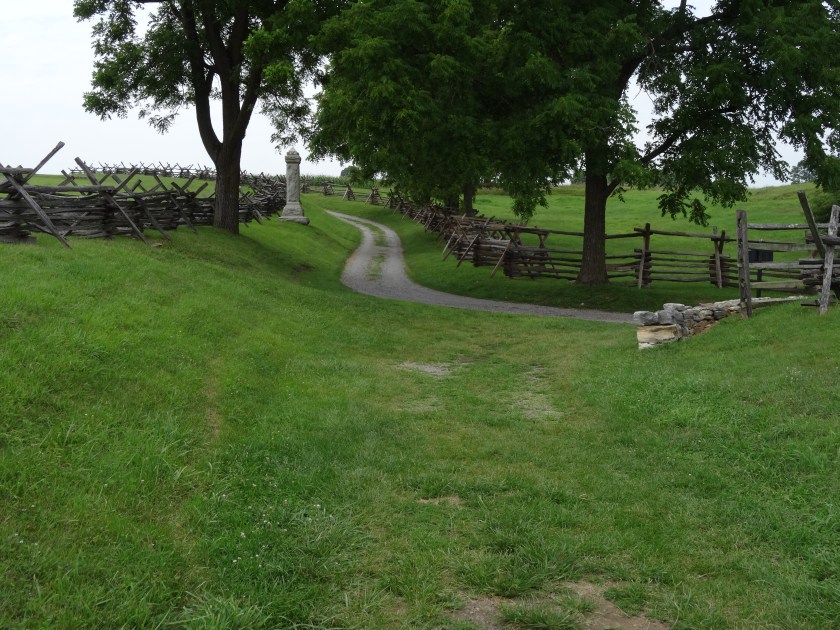
For some reason it won’t let me load the other two pictures I had for this. This is the sunken road that was the key to the second phase of the battle. The road is now called Bloody Lane because of how many men died here.
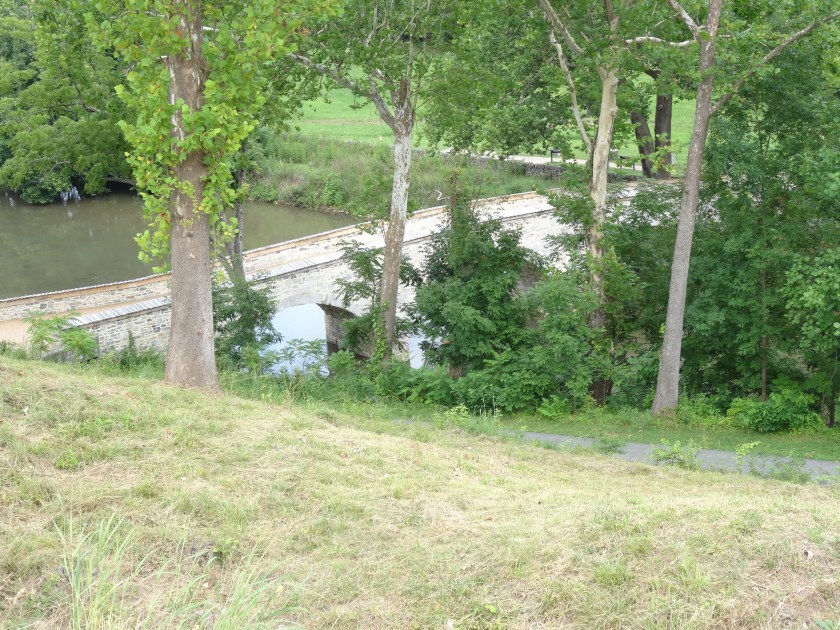
The bridge you see was called the lower bridge or Rohrbach’s Bridge, the Union officer here was assigned to push his men across and attack Robert E. Lee’s right. The Union officer spent 2 hours trying to push his 12,000 men across, opposed by about 500 Confederate troops. When he finally got across, it took another 2 hours for this officer to organize his men for an assault. This delay allowed Lee’s final division to arrive on the field in time to break up the attack, saving Lee’s army. The bridge is now called Burnside’s Bridge, in honor of the General who lost about 1,000 men trying to cross it.
I will stop there, though I could keep going. But I think by now, most of my readers will have had enough. One more thing to keep in mind here, though this is on a happier note, 5 days after the battle, and in direct response to the Union victory here (such as it was, anyway), Lincoln would issue the preliminary Emancipation Proclamation, which stated that all blacks living in areas in rebellion as of January 1st 1863, would be free. So this battle, horrific and bloody as it was, led to something good. Remember that when things get rough. Happy Road-Tripping!

 Ramblings of a Wandering Man