Ok, not quite. I’m staying in Lexington tonight, but in the morning, it’s on to Tennessee. I had some questions about what I’m eating. I’m not much of a foodie, I tend to not be to daring in my eating choices. That being said, I do try to eat at restaurants not available at home. Tonight, I ate at a place called Southern Inn. It’s a little price, but the food was pretty good. I had fried chicken (like I said, I don’t tend to branch out much, especially when I’m by myself) but it was much better than I expected. First off, it was boneless, but it didn’t look like it when it came out. I don’t know if I can explain this well. It looked like a typical fried chicken breast. But when I started eating it, I quickly realized that it was boneless. The crust was crispy, and thick but not heavy, if that makes sense.
Anyway, on to the other things I did today. I started at Appomattox Courthouse. I wandered around for a while, looking at the sights. I saw the McLean house.


Wilmer McLean had lived near Manassas. As the armies began to gather at the beginning of the Civil War, McLean’s home was used as the headquarters for General Beauregard. It gets worse than uninvited guests, though. A cannonball tore through the summer kitchen and destroyed it. After the battle, McLean moved down to Appomattox, to the house shown in the first picture, thinking that he was far enough away. But in April 1865, the war followed him. One of Lee’s staff officers was looking for a place to have the meeting that would decide the terms of Lee’s surrender. McLean reluctantly offered his parlor. You can see a recreation of the parlor in the second picture. Lee used the marble-top table, Grant used the other. Afterwards, McLean saw anything and everything in the room disappear. Some of it was paid for, but not all. In the 1890’s, an enterprising individual tore down the house, intending to move it to D.C. (or possibly New York). The plans fell through, and he just left the materials lying there. So the house is a recreation. The furniture is all recreations, though the originals are in the Smithsonian, except for Lee’s table, which is in Chicago.
I than traveled to Lexington. Lexington has done a good job of making their city pedestrian-friendly. Lots of free parking (I parked in a garage, where I could leave my car all day, at no cost!) and everything is relatively close. I went to the home of Thomas Jonathan Jackson (we know him now as Stonewall) and his wife Anna.
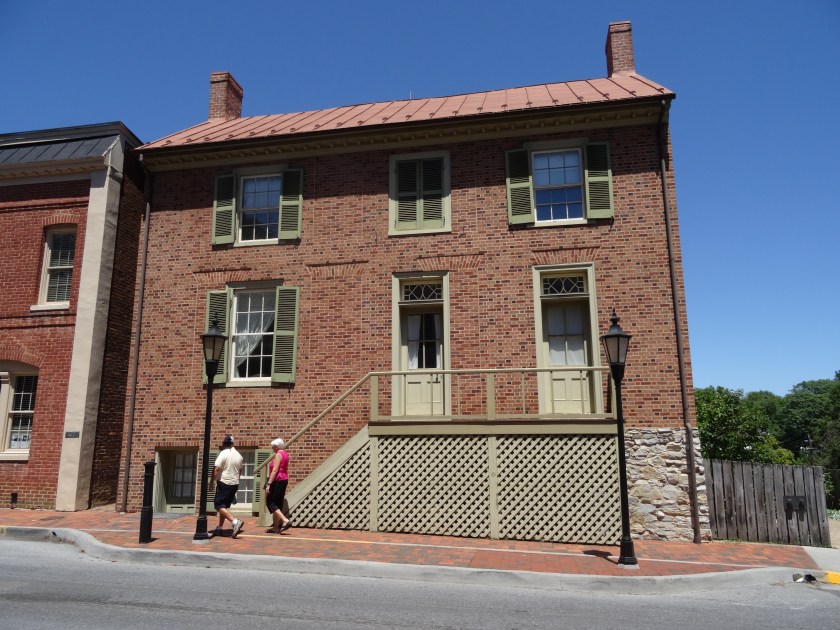
Jackson and his wife only lived here for a few years before the Civil War. In 1861 he left for war, and she went to live with her parents. They would never return.
I then walked to the campus of Washington and Lee University, where I saw the home where Lee and his wife lived out the remainder of their days. And I stopped at the Lee Chapel, where Lee attended Church, and where he is buried, along with his family (wife, parents, children, grandchildren). His horse, Traveller, is buried right outside.


This is the recumbent Lee statue, and Traveller’s grave marker, and the outside of the Lee Chapel. Note in the statue, he has his sword by his side, and his legs are crossed. This is not Lee lying in state, this is Lee resting in his tent, ready to rise at a moments notice. This is how his wife wanted him remembered.
I then traveled to the Virginia Military Institute, where I saw a memorial to VMI students killed at the Battle of New Market in 1864. Of the 10 killed, 6 are buried behind the statue. I also went to the museum there on campus, where, among other things, they have a few displays on Jackson (he taught there for 10 years).


In the display, the uniform on the left is his VMI uniform. That’s the uniform he wore at Manassas. The other coat you see is the raincoat he was wearing at Chancellorsville. If you look close, you can see the bullet hole in the left shoulder.
Finally, I walked to the cemetery where T.J. Jackson, his first wife (who died in childbirth) and their children (none of whom lived very long), his second wife and their two children (only his daughter, who was a few months old when he died, lived past infancy), his daughter’s husband, and some of his descendants.
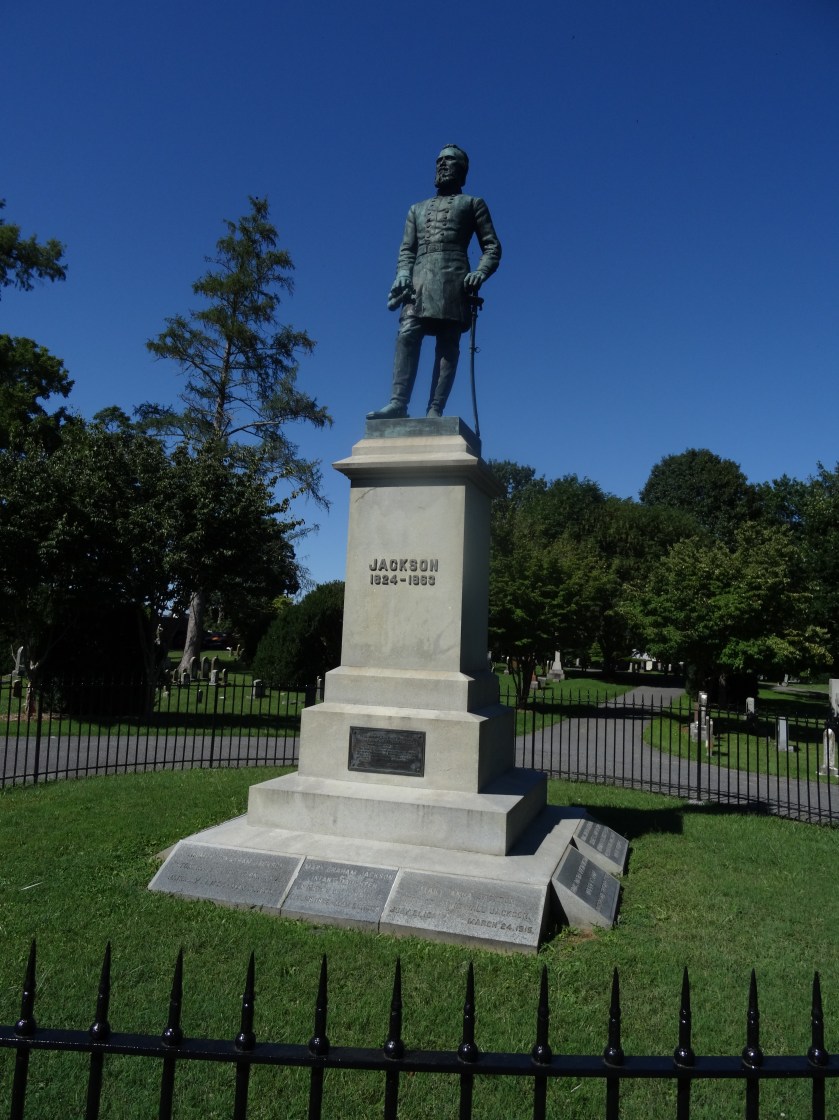
Something that might be of interest, Stonewall’s grandson was a General in the U.S. Army, and his great-grandson served in the Army Air Force during WWII, and was shot down and killed in 1944.
All in all, it was a busy day. Tomorrow will most likely be mostly driving, so I would like to ask if there is anything you (any readers still with me) might like to know, or want to hear more about. Let me know. Happy Road-Tripping!

 Ramblings of a Wandering Man